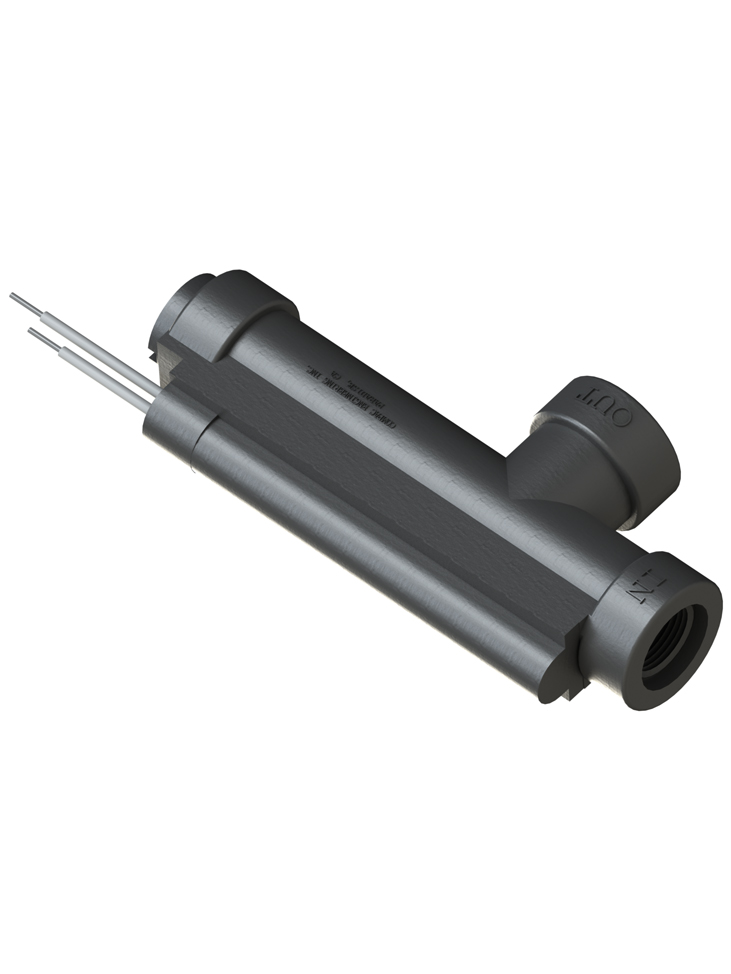
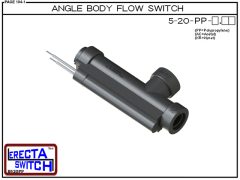
Piston-type angle body flow switch. IN port on centerline, OUT at 90°. Reed switch closes on flow. Three 9/16-18 UNF ports. Polypropylene handles water, water-based coolants, soaps, detergents, and dilute acid/alkaline solutions.
| Quantity | Price |
|---|---|
| 1–9 | $53.38 |
| 10–24 | $49.02 |
| 25–49 | $42.35 |
| 50–99 | $37.62 |
| 100–199 | $24.67 |
| 200+ | $24.67 |
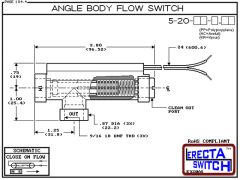
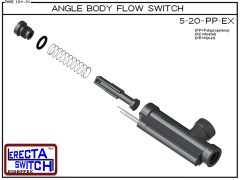
The 5-20-PP is the ERECTA SWITCH angle body flow switch in polypropylene for water-based, aqueous, soap, and mild chemical service. Liquid enters the IN port on the centerline and exits through the OUT port at 90 degrees. A spring-loaded poppet deflects at the calibrated flow setpoint, actuating a hermetically sealed reed switch (SPST N.O., closes on flow). Three 9/16-18 UNF ports — IN, OUT, and clean-out — accept Series 5 accessory fittings. Clean-out port allows poppet removal without line disconnection. Specify setpoint at order.
| Specification | Value |
|---|---|
| Series | 5-20 |
| Body | Angle — IN centerline, OUT at 90° |
| Overall Length | 3.80 in (96.52 mm) |
| Body Diameter | 0.75 in (19 mm) |
| Ports | 3× 9/16-18 UNF |
| Switch | Hermetically sealed reed | SPST N.O. |
| Contact Rating | 70 VA / 50W | 0.5A AC / 0.7A DC |
| Inductive Loads | Require external arc suppression — solenoid and relay coils. Above the rating, isolate the load with a Series 50 relay. |
| Voltage Max | 300 VAC / 350 VDC |
| Setpoints | 0.10 / 0.25 / 0.50 / 0.75 / 1.00 GPM |
| Lead Wire | 24 in (600 mm) |
| Compliance | RoHS |
| Material | Polypropylene |
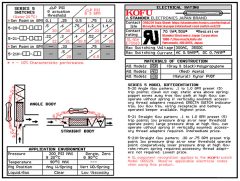
| Pressure Drop @ Actuation | 0.1 GPM: 0.5 · 0.25 GPM: 0.6 · 0.5 GPM: 0.75 · 0.75 GPM: 1.2 · 1 GPM: 1.4 PSI (water 20°C, +/- 10% characteristic performance) |
| Pressure Drop @ 3 GPM | 0.1 GPM: 30 · 0.25 GPM: 30 · 0.5 GPM: 25 · 0.75 GPM: 22 · 1 GPM: 20 PSI |
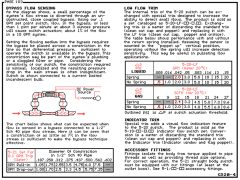
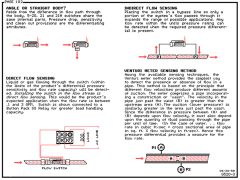
| Max Flow Rate | 3 GPM recommended — above this, install the switch in a bypass (how) |
| Pressure Max | 200 PSI @ 20°C — derates to zero at 90°C |
| Temperature Max | 90°C |
| Mounting Position | Any position with the return spring fitted; vertical only when operated without it |
| Media | Clear; low viscosity if operated without the return spring |
| Service Access | Clean-out cap — the poppet lifts out for cleaning or trim exchange without disconnecting the switch from the line. It is the third 9/16-18 UNF port. |
A flow switch answers one question — is flow above or below a setpoint — and closes an electrical contact. A meter reports a continuous rate. The 5-20-PP closes on flow through a hermetically sealed reed contact, SPST N.O., with factory setpoints from 0.008 to 1.00 GPM and a 70 VA / 50W resistive rating. No power, no display, no calibration.
Flow displaces a mechanical element that actuates a hermetically sealed reed contact — SPST N.O., so the circuit closes on flow and reopens when flow falls below the setpoint. The setpoint is factory-set, from 0.008 to 1.00 GPM, and there is nothing to calibrate. Contact rating is 70 VA / 50W resistive, 0.5A AC / 0.7A DC, 300 VAC / 350 VDC maximum.
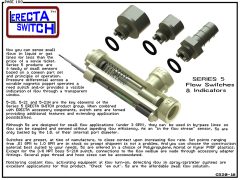
Work in this order: the setpoint, the medium, then the plumbing. Series 5 covers 0.008 to 1.00 GPM across angle body, inline, high flow, low flow and receptacle sets. Most models use 9/16-18 UNF ports and take Series 5 accessory fittings; the 5-21H connects directly to 3/8 NPT. Match the material — Polypropylene, Acetal or Kynar PVDF — to the media, not to the model.
Yes, but the numbers get large quickly, because gas is far less dense than liquid. The 5-20-LF is the only Series 5 model we publish gas setpoints for — 6 to 27 SCFM in air at 20°C, 0.5 to 8.6 PSI drop at actuation. It is also our most sensitive switch, tripping at 0.008 GPM in water, so every other model needs impractically high gas flow. Tell us the gas and the rate and we will confirm the fit.
Very little where it matters: 0.22 to 1.4 PSI at the actuation threshold, depending on body style and setpoint. At our recommended 3 GPM maximum the drop is larger and depends on the body — the angle-body 5-20 eases off as the poppet moves clear of the flow path, while the straight-body 5-21 stays near 30 PSI. Rated 200 PSI at 20°C, derating to zero at 90°C.
Yes — put it in a bypass. Above our recommended 3 GPM maximum, divert a small fraction of the flow through an unobstructed, close-coupled bypass placed across a constriction in the line. That constriction is often already there — a fitting, a reducer, even a clogged filter — and one as small as 7% is enough. A 0.1 GPM switch then actuates on about 1% of the flow in a 10 GPM system.
It depends on the return spring. With the spring fitted the 5-20-PP mounts in any position. Without it, mounting must be vertical — and in the poppet up vertical position, running without the spring increases detection sensitivity, which helps in pulsating flow. Media must be clear; without the spring it should also be low viscosity. Maximum medium temperature is 90°C.
Wire the 5-20-PP in series with your relay or controller — it is a dry contact, SPST N.O., closing on flow. Stay inside 70 VA / 50W resistive, 0.5A AC / 0.7A DC, 300 VAC / 350 VDC. Solenoid and relay coils are inductive and require external arc suppression; above the rating, isolate the load with a Series 50 relay. Leads are 24 in (600 mm).
No. There are no electronics and no field adjustment — the setpoint is factory-set and the reed contact is hermetically sealed. Maintenance stays in the wetted path: confirm the line is clear, then check continuity with flow on and off. On the 5-20 family the poppet lifts out through the clean-out cap for cleaning without disconnecting the line. If continuity never changes, replace the switch.
Keep the medium clear — that is the Series 5 requirement, and debris is the most common reason a switch stops repeating. A strainer upstream is cheap insurance. On the 5-20 family the poppet lifts out through the clean-out cap for cleaning without disconnecting the line. Worth knowing: a clogged filter raises differential pressure, which is why one can serve as the constriction for bypass sensing.
Choose the material to match the media: Polypropylene (PP) for general aqueous, acids, and bases; Acetal (AC/Delrin) for solvents, fuels, and hydrocarbons; Kynar PVDF (KR) for aggressive or harsh chemicals. Most ERECTA SWITCH models are offered in all three materials; some are material-specific, so check the product page for the model you need.
Our engineering team can verify compatibility with your application and chemistry before you order.